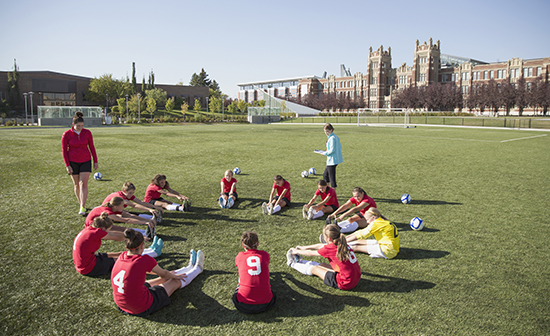
24% of head coaches
at the college level
are women.

Sabo, D., Veliz, P., & Staurowsky, E.J. (2016)
Beyond Xs and Os: Gender Bias and Coaches of Women’s Teams.
East Meadow, NY: Women’s Sports Foundation
NCAA. (2019). Race and Demographics Database.

Leadership & Coaching

Women are underrepresented in the coaching ranks and in sports leadership. In order to create change, gender bias must be eliminated and women given access to leadership opportunities.

WSF Files Amicus Brief in Crowther v. Board of Regents Case Before the Supreme Court

Supreme Court of the United States. Washington DC, USA.

WSF, with pro bono partners at Simpson Thacher & Bartlett, led and submitted an amicus brief to the Supreme Court of the United States in Crowther v. Board of Regents of the University System of Georgia, a case that will decide whether coaches and other school employees at schools receiving federal funding can sue under Title IX when they face sex discrimination from their employer. The case centers on MaChelle Joseph, the winningest women’s basketball coach in Georgia Tech history, who was fired after repeatedly raising concerns about unequal resources for men’s and women’s basketball, and Thomas Crowther, an Augusta University professor who alleged harsher treatment than female colleagues in a disciplinary process. WSF gathered 36 sign-ons, including Billie Jean King, Lisa Bluder, Muffet McGraw, the National Fastpitch Coaches Association, the National Field Hockey Coaches Association, and the Women’s Basketball Coaches Association, among others.

This action reflects WSF’s longstanding commitment to Title IX and the coaches who help enforce it. Coaches are often the first to see discrimination, and the first to speak up for their athletes; if they lose the ability to challenge sex discrimination in their own employment, many will be reluctant to advocate at all, or to take on women’s coaching roles in the first place. By uniting a broad coalition behind this brief, WSF aims to ensure the Court understands what’s at stake for Title IX’s unfulfilled promise of equal opportunity in sports.

Read the full brief here.
Creating Gender-Neutral Coaches’ Employment and Compensation Systems

The purpose of this resource manual is to assist athletics administrators in the design and the implementation of consistent, gender neutral employment systems specific to coaches working in educational institutions. The manual also serves to provide an educational resource for coaches that can be used to evaluate and negotiate their existing or prospective employment situations. It is essential that all employees of any organization have a clear understanding of what is expected of them, how they are going to be evaluated, and what criteria will be used to determine salary and other employment variables.

Creating Gender-Neutral Coaches' Employment and Compensation Systems (pdf)

Special Issues for Coaches of Women’s Sports

So, you are a coach. Fabulous! We’re excited for you. You probably love working with kids, have your own deep and wide sport’s story plus relish both the challenge and the competition. We also suspect you see coaching athletes as a real contribution to a person’s character development—beyond the skills and physical acumen individuals acquire. Whatever your reasons for being a coach, we hope that you are thrilled and empowered with your role, most of the time.

We also know that there are events and circumstances that will really get in the way—almost making it impossible for you to have a positive season and return to coach again. We’re not talking about just having a losing or lousy season, because if that was the case, half of us would routinely disappear. We are talking about the institutional and relationship problems that go with the job, but are all too rarely taught or talked about. We’ve been listening for decades, as the Women’s Sports Foundation fields coaches calls and e-mails daily.

The purpose of this guide is to help coaches prevent, respond to or even initiate action when faced with difficult professional situations. The format includes commonly (and yes, frequently) asked questions and answers. Now and then, we’ve also provided a TIP, something to take our Theory Into Practice. Suggested resources addressing coaching problems and issues are also listed in the final section.

Special Issues for Coaches of Women's Sports (pdf)