
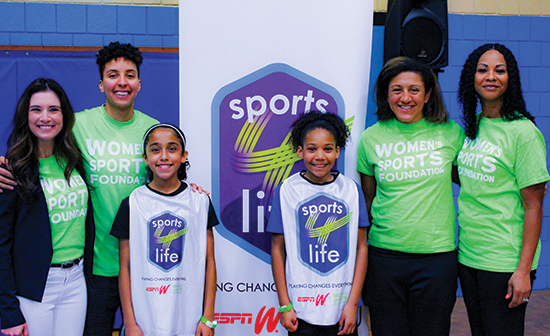
On April 27, 2019, the Women’s Sports Foundation, ESPN Women’s Group and SOMOS volunteers combined forces to host a basketball clinic for 60 girls from our Sports 4 Life community program, Hispanic Coalition. WSF President and three-time Olympic medalist in bobsled Elana Meyers Taylor, WSF Athlete Ambassador and WNBA All-Star Layshia Clarendon, ESPN Reporter and Host Jen Lada and Waterbury Police Detective Andréa Saunders made up our stand-out panel prior to the clinic.
WATCH: WSF and ESPN Host Girls’ Basketball Clinic in Connecticut
Good As Gold: Get to know Olympic ice hockey champion Lee Stecklein
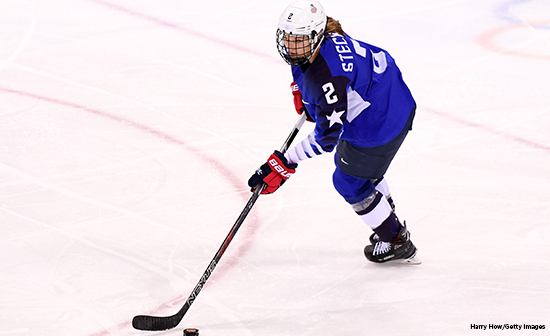
At age 24, Lee Stecklein has accomplished more than many people do in a lifetime. Playing defense for the U.S. national women’s ice hockey team, she won a gold medal in her second Winter Olympics last year in PyeongChang, South Korea. It was the first U.S. gold since the inaugural 1998 Olympic women’s hockey tournament. Stecklein’s average ice time of 22:27 per game led the team.
Captaining the Minnesota Whitecaps in the team’s first NWHL season, Stecklein also scored the overtime winner against the Buffalo Beauts in the 2019 Isobel Cup final. The Roseville, Minn. native has also won three NCAA championships with the University of Minnesota Golden Gophers and four straight IIHF Women’s World Championships. We chatted with her during the U.S.’s quest to five-peat at the Women’s Worlds in Espoo, Finland, in which she has helped the Americans qualify for the semifinal match after a 4-0 win over Japan earlier today.
WSF: What is the most important reward that Olympic gold medal gave you?
LS: Knowing we were growing women’s hockey overall was incredibly important to all of us. Being able to bring it back to our communities was really important, too. And accomplishing it with our special group – it was a long year of training together, so to have that pay off in the end was incredibly exciting.
WSF: How do you feel playing sports and being physically active has benefited you?
LS: Being physically active has been a huge part of my life. I’ve learned so much from sports in general. I think it’s really important that girls stay in sports. I saw a statistic from the Women’s Sports Foundation that girls are dropping out at twice the rate by the age of 14. And I just can’t imagine where I would be without hockey or soccer or any of those things in my life. I’ve learned a lot of lessons, and I have a lot of great friends through sports. It’s something I hope to keep in my life. I feel grateful to have had those opportunities.
WSF: During the NWHL All-Star Weekend in Nashville, Tenn., you spoke at the Play Like A Girl summit, along with other female athletes and executives, before girls aged 13 to 17. What was your message?
LS: Stay in sports for as long as you can. Learn as much as you can from them. The on-ice or on-court or whatever stuff you’re doing is important, but you’re learning so many other lessons. Just be open to those. Ask questions, and keep pushing yourself each and every day. It was really exciting to see the girls there. They had to sign up, and they were clearly engaged to listen to the panel.
WSF: Who are your heroes in hockey and in life?
LS: Someone who’s been a role model for me in both areas has been [two-time Women’s Worlds silver medalist and Whitecaps veteran] Winny Brodt. Growing up, she was someone I watched. She played at Roseville High School and for the Gophers, and then played with the U.S. national team. So as someone who had grown up right near me, who had a niece my age that I grew up playing with, Winny had a career that I always followed. She really gave back to the community. She’s still coaching and helping girls’ hockey in Minnesota today. Just to see how she used her career to help others is something I find inspiring.
WSF: Some people might see your hockey resume and say you’ve already done it all. What do you feel like you have left to accomplish?
LS: In this sport, I think we can always keep striving to make it better overall, to keep improving the level of women’s hockey. We’re doing amazing things, and I’d like us to continue to show that to the world. And then, to keep playing in gold medal games for as long as I can!
Lucas Aykroyd is a member of the WSF Digital Contributor Team. His work has appeared in publications that include the New York Times.
The Golden Goalie: Meet Olympic Hockey Star and 2018 Team Sportswoman of the Year Maddie Rooney
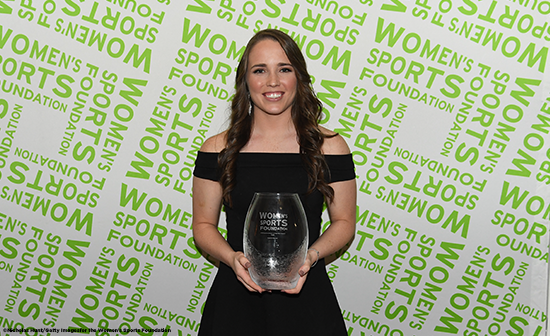
When Maddie Rooney headed to the 2018 Olympics in Pyeongchang, South Korea, she was a relatively unknown 20-year-old hockey goalie. By the time the Winter Games ended, the University of Minnesota-Duluth (UMD) Bulldogs star had become a household name.
Rooney made the iconic, deciding save in the gold-medal shootout versus four-time defending champion Canada. It came against 2010 Olympic MVP Meghan Agosta. It was the first Olympic women’s hockey gold medal for America since the inaugural 1998 tournament in Nagano, Japan.
This Andover, Minnesota native is just getting started. Rooney was honored as WSF’s Team Sportswoman of the Year at the 39th Annual Salute to Women in Sports awards gala on October 17 in New York. We caught up with her at the 2018 Four Nations Cup in Saskatoon, Canada, where the U.S. earned its fourth straight title with a 5-2 win over the host Canadians on November 10.
WSF: What did it mean to receive the Team Sportswoman of the Year Award from the Women’s Sports Foundation?
Maddie: Just to be nominated for that meant so much to me. I was up against so many incredible athletes, and to go to the event was a super-humbling experience, with all those elite athletes coming together. We worked with young girls there the day before the event. To hear Billie Jean King speak both early in the day and at the event, it was so cool to be part of.
WSF: How has the Olympic gold medal changed your life?
Maddie: I guess I never really saw myself being on Jimmy Fallon or Ellen or all those crazy things we experienced! But again, it’s just been so humbling. Now, with the start of a new Olympic quadrennial, it’s about getting focused on the team again.
WSF: WSF strongly advocates for scholarships for female athletes. How has your UMD scholarship affected your ability to excel?
Maddie: Getting a scholarship has changed my life and given me the opportunity to play for Team USA. It’s given me so many life lessons, like time management and communication, that I can carry with me throughout my life, not just in the game of hockey, but outside as well.
WSF: What can you say about the importance of girls participating in sports for health, confidence, and leadership ability?
Maddie: When I was young, I participated in many different sports. That was huge for me to develop those skills and get involved with the community. I met some of my best friends. I think that’s just part of the development. It helps you be the best version of yourself.
WSF: Team USA has other top-notch goalies, including Alex Rigsby, who helped the U.S. win the 2015 and 2016 World Championship gold medal games, and Nicole Hensley, who won the 2017 World Championship final. What kind of relationship do you have with them?
Maddie: It’s all based on support of each other, and you’ve got to have fun with each other. You obviously compete too, but we’re all working for the same goal.
It’s given me so many life lessons, like time management and communication, that I can carry with me throughout my life, not just in the game of hockey, but outside as well.
WSF: In 2017, your national team famously announced it would boycott the Women’s Worlds in Plymouth, Michigan unless it received equitable treatment from USA Hockey. Ultimately, a deal was struck. What was that like?
Maddie: I was new to the team, and being told that we were looking at sitting out the tournament wasn’t ideal. But it was really powerful that we all stood together. I was proud to be part of that team. What we accomplished set a baseline for women’s hockey and women’s sports in general.
WSF: How optimistic are you that women’s hockey players will soon get the opportunity to earn a living in a unified top pro league?
Maddie: I think it’s really going to develop within the next two years, and I’m excited to see what opportunities I have once I graduate. It’s great to see how far it’s come.
Lucas Aykroyd is a member of the WSF Digital Contributor Team. His work has appeared in publications that include the New York Times.